• Home
  • “1-a-Day Album Project”
  • Articles
  • Blog
  • Contact
Menu

Robert Bittner

Street Address
City, State, Zip
Phone Number
Freelance writer, musician, tech fan, cat lover

Freelance writer, musician, tech fan, cat lover

Robert Bittner

  • Home
  • “1-a-Day Album Project”
  • Articles
  • Blog
  • Contact

Day 11: The Red Hot Chili Peppers, “Blood Sugar Sex Magik”

August 18, 2022 Robert Bittner

When: Released September 24, 1991 (coincidentally, the very same day as Nirvana’s “Nevermind”)

Why? I’ve never heard a Chili Peppers album; I’m only familiar with two of the tracks from this, with “Give It Away” being one of my favorite tracks of the decade.

What? 17 songs, one hour and 14 minutes. While this is not their most popular album, it is considered the band’s breakthrough and a foundational album in 1990s alternative rock.

First Impressions: My nutshell review: It’s overlong, but I really enjoyed it.

My familiarity with funk rock pretty much begins and ends with Prince. And while he and the Peppers tread similar territory regarding relationships and, particularly, sex, their world views couldn’t be more different. Prince explored sex as part of a spiritual experience in which one lover serves the other. With the Peppers, the man is always the one being served and sex is just about genitals. Not that everything here is about sex: there is a range of experience and varying depths of emotion represented here. It’s just that even when the Peppers aren’t singing about sex—“Give It Away” is apparently not about anything sexual at all, despite many listeners’ impressions—it often feels like they are.

That said, these guys know how to funk.

I don’t think the opening and closing tracks for this album do them any favors, though. “The Power of Equality” has a great message, terrific verses, and an incredibly funky groove. But its chorus feels like a rushed afterthought. And it leads straight into one of the weaker tracks on the album, “If You Have to Ask,” which feels like pure B-side filler to me. (But maybe I “have to ask” and just don’t get it.)

Then we shift gears, going from strength to strength—the album’s high points are many, including “Funky Monks,” “Give It Away,” and “Under the Bridge”—until we hit the album’s final four tracks, starting with “The Greeting Song.” Apparently, even lead singer/songwriter Anthony Kiedis now hates everything about this song. I wouldn’t say I hate it, but it doesn’t belong on this album. (I’m ambivalent about the next song, “My Lovely Man.” I sympathize with the meaning behind it, along with Kiedis’s need to write it, but it’s just okay to me.)

And then there’s “Sir Psycho Sexy,” in which Kiedis revels in sexual, misogynistic fantasy; it’s juvenile and mean-spirited. Lyrically, it’s the lowest point on the album. (And this same ground was covered earlier—and somewhat more positively—in both “Apache Rose Peacock” and the title track.) For the final real song on the album, it’s an unfortunate choice.

For the final final song on the album, an ultra-fast cover of Robert Johnson’s “They’re Red Hot,” there’s not much I can say. It’s a fun throwaway that would have worked better as a hidden track.

The performances here are outstanding. Kiedis’s voice can change cadence and tone on a dime to suit the material, and I can’t imagine anyone delivering lyrics like he can. Flea’s bass playing—which he has described as “simplified” from the previous album!—is nonstop, moving effortlessly from foundational low-end support to funky accents and melodic lines. John Frusciante’s guitar is tasteful, versatile, and joyfully funky, while Chad Smith’s drumming drives the rhythm section’s groove. This feels like a real band, not just a group of musicians.

So? Despite a handful of songs I didn’t like, I really enjoyed this. I’m sure I’ll be listening again.
In Album Appreciation, 1-a-Day Album Project Tags Flea, Anthony Kiedis, John Frusciante, Chad Smith, funk rock, Prince, Give It Away

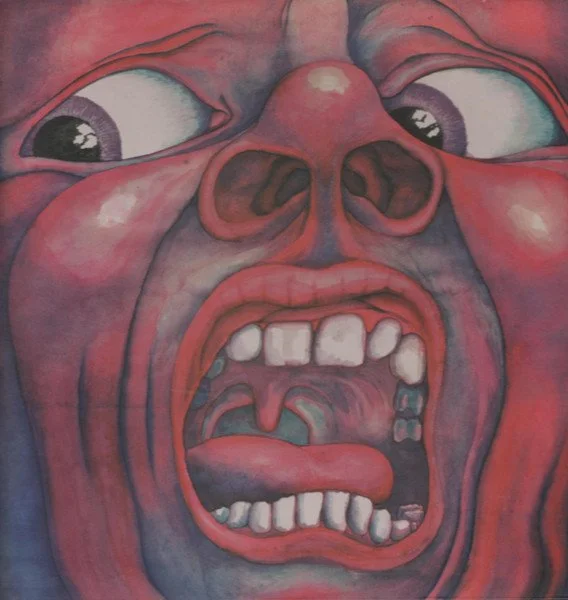
Day 10: King Crimson, “In the Court of the Crimson King”

August 17, 2022 Robert Bittner

When: Released October 10, 1969

Why? I’ve never heard a King Crimson song, and this, their first album, is considered a foundational album in the development of progressive rock and a significant influence on early Yes and Genesis. Also, I’ve been seeing the eye-catching cover of this album in racks since I was a young teenager.

What? Five songs, averaging about nine minutes each (lasting 44:28), that blend pop, light rock, jazz, classical, and experimental sounds.

First Impressions: With opener “21st Century Schizoid Man,” we’re given a comprehensive introduction to what the rest of this album holds: Lyrically meaningful songs accompanied by lengthy (and often experimental) instrumental passages.

These are not throwaway pop songs; the lyrics throughout focus on war, social injustice, humanity’s search for meaning. The musicianship on display is remarkable to the point of being virtuosic, with drummer Michael Giles, in particular, demonstrating incredible technical skill on every track.

Personally, though, I tired of the way the band would essentially finish an actual song (i.e., the part with lyrics) and then continue down often unrelated, jazz-based instrumental excursions for five or more minutes. I physically reached the limit of what I could take when the hauntingly beautiful “Moonchild” devolved into maybe 8 minutes of unnerving “instruments as sound effects” experimentation that offered nothing I could call music and filled me with anxiety. I had to skip the last 5 minutes.

So? I realize that King Crimson’s blend of pop/rock and freeform jazz is one of the hallmarks of progressive rock. While I recognize the musicianship required to conceive and play such challenging music, the fact is that I prefer songs. And when it comes to instrumental breaks or even extended musical explorations, I respond best to melodies and structure; I want them to mean something. So when King Crimson delivered songs, I enjoyed them very much. But because of how this material is presented—with many minutes-long instrumental breaks and lengthy instrumental endings—I don’t see myself wanting to sit through this album again.

In 1-a-Day Album Project, Album Appreciation Tags King Crimson, Yes, Genesis, prog rock

Day 9: Patti Smith, “Horses”

August 16, 2022 Robert Bittner

When: Released November 10, 1975

Why? I’ve never heard a Patti Smith song, and she and this album are frequently cited as having planted the seeds for what would become punk music.

What? Eight songs, 43 minutes.

First Impressions: This is one of those times when I fear that it’s nearly impossible to base a judgment on a single listen. But here goes…

This is contemporary poetry of the highest order, often delivered in poetry-slam style with a conviction and insistence that demands we listen. But it isn’t out to shock (necessarily) or be abrasively in your face: It’s insistent not out of anger or rebellion but because the messages seem so personally important to the artist behind the words.

While most of these songs are lengthy, I never felt that any were overlong. They are telling stories with multiple layers, often delivered in multiple sections, that rise and fall, push and pull. There is an hallucinatory quality to much of the imagery here, which will certainly reward deep and repeated listening.

Apple Music—and every reviewer I’ve read—labels this album “punk.” But if you expect Sex Pistols, you’ll be disappointed. As the Apple Music liner notes state, “Calling Horses one of the first statements in punk begs the question of what punk is: A sound? An attitude? A political orientation? A stylistic one? In some ways, Smith was a traditionalist.” That’s most clear in the instrumentation, which can be surprisingly spare, artfully interacting with Smith’s lyrics.

Here, “punk” has nothing to do with the sound, which is sometimes tinged with Fifties jazz, sometimes Seventies rock. Instead, it’s an attitude, a willingness to break down barriers and kick open doors. Consider the opener, “Gloria,” a cover song. Smith takes a raw-sounding popular track by Van Morrison’s band Them and turns it on its head—adding multiple new verses of her own storytelling and flipping the song’s gender to create something truly thrilling.

This feels corny to say, but each song here truly is a multifaceted jewel.

In addition to “Gloria,” highlights for me include “Redondo Beach,” the hallucinatory journey of “Birdland,” “Kimberly” (this song in particular made me think Smith’s vocal delivery was a strong influence on Blondie’s Debbie Harry), and “Land.”

So? Almost 50 years on from its initial release, this album still feels both fresh and relevant. I have no doubt that it will reward multiple plays over the course of many years. It is true, timeless art.

In 1-a-Day Album Project, Album Appreciation Tags Patti Smith, Debbie Harry, Blondie, Gloria, Redondo Beach, punk music

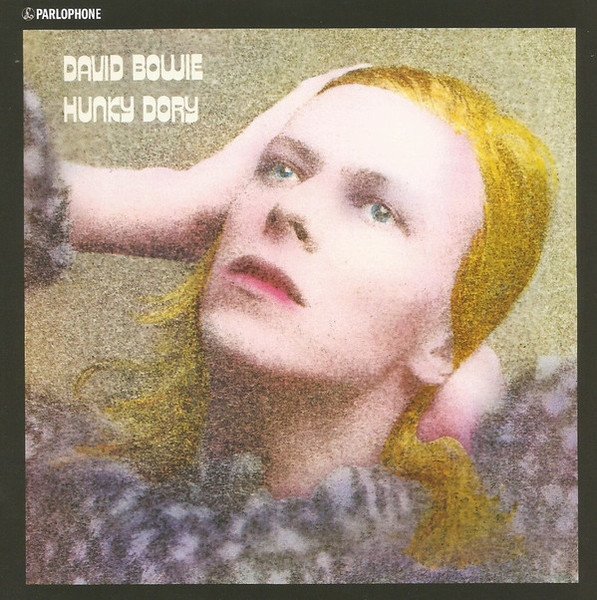
Day 8: David Bowie, “Hunky Dory”

August 15, 2022 Robert Bittner

When: Released December 17, 1971

Why? I’ve only heard a few of Bowie’s radio singles, never an album that helped establish his reputation. “Hunky Dory” is often cited as Bowie’s first great album, the one where he finally found his voice. A couple of musicians I respect—notably Dave Stewart and K.T. Tunstall—consider it highly influential on their work. Tunstall calls it her favorite album.

What? Eleven songs, 42 minutes. An esoteric collection of pop songs ranging from straightforward to art-pop and musical hall. Lyrically, it includes psychedelic stream-of-consciousness prose poems, a loving song for his new son, reflections on fame and maturation, and at least one song that seems to verge on parody.

First Impressions: The most surprising thing for me was how acoustic and piano-driven it is. With the exception of one or two songs, there is very little electric guitar. A synthesizer seems to only appear in the intro to one song; the dominant keyboard is piano, which is everywhere (and very well played by Bowie and Rick Wakeman).

Previously, I was only familiar with “Changes,” the big hit from this album. It was my favorite track. I also enjoyed “Oh! You Pretty Things,” “Life on Mars?,” and “Kooks.” I can definitely see myself adding all of those songs to a playlist.

Of the remaining seven tracks… I enjoyed hearing them—I ended up listening to the whole album twice—but they didn’t resonate with me. The melodies meandered. Lyrics ranged from understandable but unrelatable (for me) to obscure. The generally sparse arrangements seemed to work well in support of the songs, but I was often left wondering why anyone bothered. Is the cover song “Fill Your Heart” meant to be a parody? ironic? Is there a point to an “Eight Line Poem” about a cactus on a windowsill? Is the seemingly nonsensical “The Bewlay Brothers” really worth the effort of trying to parse out all of the hidden autobiographical hints and allusions critics have since begun to see in it?

Three “tribute” songs (for Andy Warhol, Bob Dylan, and Lou Reed) make up the bulk of the album’s second half. I’m not surprised Warhol reportedly didn’t care for his song; there just isn’t much to it—and what is there doesn’t seem flattering. I thought Dylan fared better in terms of the songwriting. Bowie’s song for Reed, “Queen Bitch,” is as close as the album comes to a rocker. But, again, it’s not the most flattering portrait.

So? Maybe Bowie just isn’t my taste beyond a few popular singles. Maybe this is one of those albums that you can only really appreciate if you were there when it was released. Or maybe it’s best appreciated by those who knew Bowie’s work before “Hunky Dory” and can better understand what its songs represented for him and his career.

I’m glad to have heard this. I discovered a couple of tracks I will enjoy listening to again. But it isn’t an album I’d go out of my way to revisit in its entirety.

In 1-a-Day Album Project, Album Appreciation Tags Life on Mars?, Rick Wakeman, David Bowie

Day 7: Nirvana, “Nevermind”

August 14, 2022 Robert Bittner

When: Released September 24, 1991

Why? Other than “Smells Like Teen Spirit,” I’ve never heard a Nirvana song. This album has sold over 30 million copies and is frequently ranked among the greatest albums of all time. Also, it seemed fitting to listen to this after “Never Mind the Bollocks,” as Kurt Cobain has said that this album was named after it.

What? 13 songs, 49 minutes. This is Nirvana’s second album and the first to feature drummer Dave Grohl.

First Impressions: Maybe I’m being overly influenced by having just listened to “Never Mind the Bollocks,” but in many songs this feels like a more polished, more mature, and more personal take on punk. Often the lyrics are baffling and obscure; without modern resources that explain their background and meaning I wouldn’t have a clue what they were about. But I think maybe that’s kind of the point: sometimes it’s more about the sounds of the words than their literal meaning (which is, I think, a Sex Pistols thing to do).

To some degree, I enjoyed every track on the album—except for track 13, “Endless, Nameless,” which should have been titled, “Endless, Pointless.” On the original LP, it appeared as a hidden track after 10 minutes of silence following track 12. It should have remained hidden.

“Smells Like Teen Spirit” features a positively powerful musical chorus underscoring great phrases (“Here we are now, entertain us”) as well as words-as-sounds (“A mulatto, an albino, a mosquito, my libido”). Other highlights for me include: “In Bloom,” “Come As You Are,” “Lithium,” “Drain You,” and “On a Plain.” Learning the backstories of “Polly” and “Something in the Way” was helpful in appreciating those songs; although they weren’t among my favorite tracks on the album, I welcomed the change of pace they brought to the mix. (Although once you know the backstory for “Polly,” the song becomes a difficult listen.)

Instrumentally, I enjoyed the guitars and bass playing (and appreciated the addition of cello on one song!) but I especially was impressed by Dave Grohl’s powerful drumming.

I enjoyed Kurt Cobain’s singing but didn’t feel any immediate personal connection to his voice. That may come with repeated listens. The very few times harmonies were used, I liked them and wanted more…but maybe vocal harmonies aren’t very “punk” or “alternative.”

So? For some reason, I’ve had this bias against Nirvana and the whole grunge scene. The few songs I’ve sampled from Dave Grohl’s post-Nirvana Foo Fighters have sounded generic and bland to me, and nothing I’ve heard from them, Pearl Jam, and their ilk has made me want to hear more. So I was surprised to discover that I actually liked this. I will listen again.

In 1-a-Day Album Project, Album Appreciation Tags Kurt Cobain, Dave Grohl, Smells like teen spirit, Lithium
← Newer Posts Older Posts →

Powered by Squarespace